Blog archive · 22 May 2023 · Matthias Eger
Things are moving in many offices:
when AI hits.
At the dawn of a new era, artificial intelligence is changing our everyday life — at a speed that outshines the lights of a meteor shower in the dark of night. In the office above all, where digital transformation feels like ever-growing pressure, that change is particularly striking.
 AuthorMatthias EgerCertified Manager for Applied AI Transformation (IHK)
The assumption that AI will destroy jobs is widespread by now. But like a good gardener who prepares the soil instead of destroying the plants, AI will not eliminate jobs, it will change them lastingly. It is a tool that allows us to make full use of the potential of the human mind — by freeing us from monotonous and repetitive tasks.
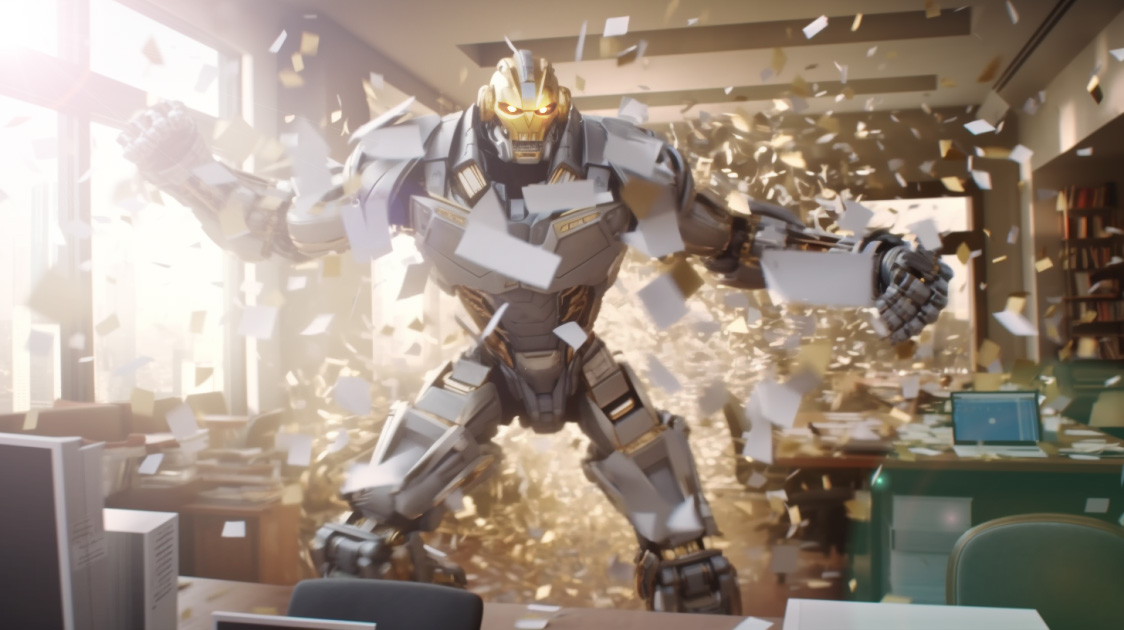 AI-generated
Are we afraid?
AI is not only a tool, it is an enormous help — a lamp that lights the path to efficient and productive work. Take the processing of large volumes of data: in the past that task resembled an endless caravan through the desert of an ocean of data. Today, with AI-supported algorithms, we fly across that ocean — on the wings of a technological albatross.
AI-based algorithms analyse data faster and more precisely than ever before. They help to spot hidden patterns and to notice every relevant detail, however small. That allows companies to make well-founded decisions and to use resources efficiently. The benefits are not limited to data analysis, though: with AI-driven chatbots that never sleep and never tire, companies offer their customers service around the clock — an army of tireless helpers.
Just as impressive is the role of AI in automation: from arranging meeting dates to managing workflows, AI-supported systems act as invisible assistants. Through machine learning, AI constantly improves its abilities and adapts to new situations — a system that grows and develops with us.
Facts instead of pretty metaphors
Against the background of all these changes it is easy to understand why some people look at AI with scepticism — as if we were standing at the threshold of an unknown country. Let us meet that change with facts:
- Automating routine tasks: in the office, AI automates time-consuming, repetitive tasks such as scheduling, sorting email and writing reports — staff gain time for more creative and more strategic work.
- Better project management: AI-based tools track tasks, assess progress and predict, based on historical data, which projects are at risk of missing their deadline.
- Predictive analytics: AI analyses huge volumes of data and recognises patterns and trends that would be hard for people to spot — a basis for forecasts and better decisions.
- Programming aids: AI detects and fixes programming errors automatically — which makes the process more efficient and less error-prone.
- Generative programming: AI systems generate code from high-level requirements — programming becomes faster and easier.
- Better information management: companies collect, organise and analyse information from many sources far more efficiently. That reduces information overload — and the simplicity makes it accessible to smaller firms in particular.
- Automated document processing: AI processes documents and forms automatically — faster and more accurately.
- Chatbots in customer service: AI-driven chatbots answer customer enquiries around the clock — better service, happier customers.
- AI in graphic design: automated designs, logos, flyers; image subjects are cut out, retouched and adjusted in milliseconds — even in real time.
- Artificial creativity: with techniques such as generative adversarial networks (GANs), AI creates images, music and texts that are hard to tell apart from human creations.
Two examples from my own surroundings
Automating bookkeeping and finance processes
Bookkeeping is time-consuming and complex — especially for smaller firms without a large accounting team. From issuing invoices through tracking expenses and income to preparing tax returns, all of it eats up considerable time.
AI-supported accounting software automates a large part of those processes: generating and sending invoices, categorising expenses and income automatically, tracking payments, producing financial reports, preparing tax returns. It even detects anomalies in the financial data — and so helps to spot errors or fraud early.
That not only saves smaller firms time and money, it also improves the accuracy and efficiency of bookkeeping and finance processes.
Off-the-shelf logos? Hardly. AI creates creative logos.
In graphic and logo design, the automated creation of logo designs is a good use case for AI.
Traditionally a professional graphic designer creates several concepts and discusses them with the client — depending on complexity and the number of revisions that takes days or weeks.
AI-supported design tools create logo drafts automatically according to the user’s specifications: enter colours, style and industry, receive several designs to choose from — in a few minutes instead of weeks.
Smaller firms thus get professional-looking logos quickly and cheaply. AI tools also help to keep the design consistent across platforms and media — for a stronger, more coherent brand image.
What is coming?
Whether we like it or not: artificial intelligence marches on and casts its shadow — or, depending on your perspective, its light — on every facet of our lives. Like a mighty river that inevitably finds its route, it reshapes our everyday life, our work and even our idea of creativity.
The question is no longer whether AI changes our lives — it already does — but how we, as a society, as companies and as individuals, ride that wave. The odds are in our favour if we are brave enough to seize them and wise enough to use them responsibly.
Written in 2023 — a duty today.
Since February 2025, Article 4 of the EU AI Act has required AI literacy in the team. The AI day brings rules and skills into your business.